How I Learned to Read Games From the Inside
I beat The Legend of Zelda when I was four years old. There is a photo of it somewhere, and we have been turning the house upside down trying to find it. I don't remember the moment, but I've spent the thirty-something years since trying to understand why some games grab you by the collar and never let go, and why others, with bigger budgets and prettier art, just don't.
That question is my whole career now. But it started somewhere much smaller: a pawn shop, and a mall food court, and a five-dollar bill.
The pawn shop
My parents owned a pawn shop, which meant games came through the door constantly: cartridges, consoles, PC boxes, whatever people needed to turn into cash that week. I got to play almost everything up through the PlayStation 1 era without ever buying it. That's an unusual way to grow up as a gamer. Most kids get the two or three titles they can afford and play them into the ground. I got breadth: hundreds of games, across every genre, back to back.
When you play that many games that fast, you stop seeing them as toys and start seeing the machinery. Why does Herzog Zwei, a 1989 Genesis game almost nobody remembers, quietly invent the entire RTS and MOBA genre a decade before anyone else? Why does Might and Magic III still live in my head, down to the exact spot in the woods where a goblin's brother ambushes you because you ate goblin soup twenty hours earlier? Why did Road Rash 2 feel perfect and Road Rash 3 kill the series? I couldn't have told you the vocabulary for it back then. But I was already doing the work: taking games apart to see what made them tick.
At ten, I was building my own D&D levels. The disks I had bundled Forgotten Realms: Unlimited Adventures, a construction set on the same Gold Box engine as Pool of Radiance, and I used its level editor to make a whole world: a level-appropriate town, sewers beneath it, a rat fight under the pub, a lizardman village, text encounters, battles that were fair but actually hard. This was back when the game checked a random word from the paper manual to make sure you hadn't pirated it. I didn't have a word for "encounter design" or "difficulty curve" yet. I just knew when a fight felt cheap versus earned, and I tuned mine until they felt earned.
The five-dollar bill
By fifteen I'd found the arcade cabinets at a mall east of downtown Orlando, and I'd found Marvel vs. Capcom.
Here was the routine. I'd show up with ten dollars. I was good enough that I could win twenty straight matches on a single fifty-cent credit, because the machine let the winner keep playing, so if you didn't lose, you didn't pay. Twenty opponents on two quarters. Then I'd buy lunch. Then I'd sit back down and run another ten or twenty rounds on another fifty cents. And I'd still have bus fare home.
That wasn't about being a cheapskate. It was the purest feedback loop I've ever been in. Every quarter I didn't spend was a scoreboard. Getting better wasn't abstract. It was lunch, it was more play, it was the ride home. The mall crew all showed up every week to settle it, and I beat everyone badly enough at the Neo Geo fighters that people just stopped sitting down across from me. (There was exactly one guy I couldn't crack. He'd memorized every character's combos and exploits frame by frame. Respect. He earned it.)
I didn't know it then, but I was learning the thing I now get paid for: how game feel and reward loops actually change human behavior. A tight execution window, a fair-but-punishing skill ceiling, a reward that connects directly to getting better. That's not just fighting games. That's every good game, and it's the first thing I look at when someone hands me a broken one.
Four games at once
Fast-forward to 2007. That year I finished Top 4 at a D&D Miniatures Constructed Championship qualifier, which came with an invitation, plane, and hotel to the World Championship at Gen Con Indy. The same year, I qualified for the $50,000 Dreamblade Championship at the same convention. I was a Wizards of the Coast Delegate, running sanctioned events and demoing products at stores. And I'd been invited into the alpha test for Magic: The Gathering Online out of the old MTG Encyclopedia community.
Four different games. Tactical miniatures, a board-control strategy game, event organizing, and a deckbuilding card game, all at a high level, all in the same stretch of my life. That's the part I care about most. I was never a one-game specialist. I was fluent in systems: how a deck's economy balances, how positioning wins a miniatures match, how a card game's metagame breathes. Different surfaces, same underlying grammar.
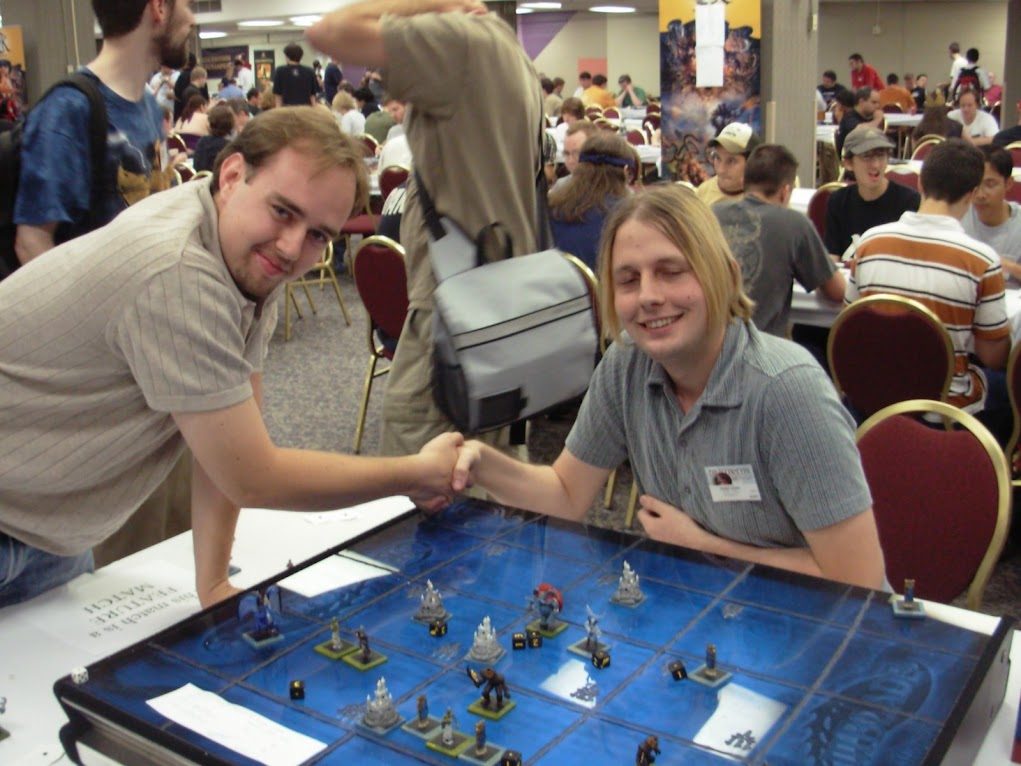
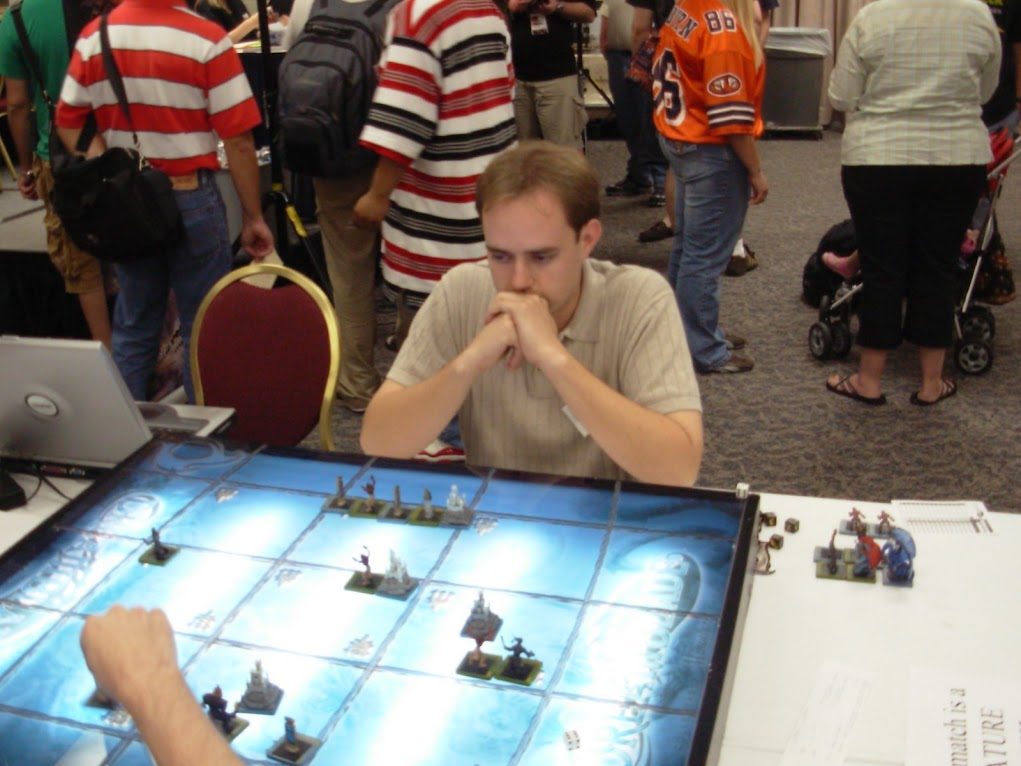
I'll tell you a story that captures the whole era. I flew to Magic Worlds in New York that year, crashing with a friend named Derek, until I showed up and found out he'd given the room to a girl for the night. I couldn't find a hotel, couldn't afford one anyway, so I ended up napping on the couch of a game shop while the guys there played Guitar Hero, hoping they wouldn't kick me out because it was freezing outside. That's competitive gaming in your twenties: fifty-thousand-dollar championships and a game-store couch, same weekend.
Why this matters if you're building a game
Here's the point of all of it.
I didn't learn games from a textbook or a bootcamp. I learned them the way you learn a language you grew up speaking: thousands of titles, four competitive scenes at once, decades of taking every game apart to see the gears. When you hand me your game, I'm not guessing at what "feels off." I've felt the difference between earned and cheap ten thousand times, in every genre, and I can usually tell you exactly which gear is grinding.
That's what I do now: I build games with an AI-accelerated pipeline, and I help other developers fix theirs. The four-year-old who beat Zelda, the fifteen-year-old stretching a five-dollar bill, the guy on the game-shop couch. They're all still in the room when I look at your build. And they've got opinions.
Send me what you're working on. The first fifteen minutes are free.